 AliviaQ
Sanitation and Water Protocols in Venezuela's Temporary Camps: A Field Guide for Physicians
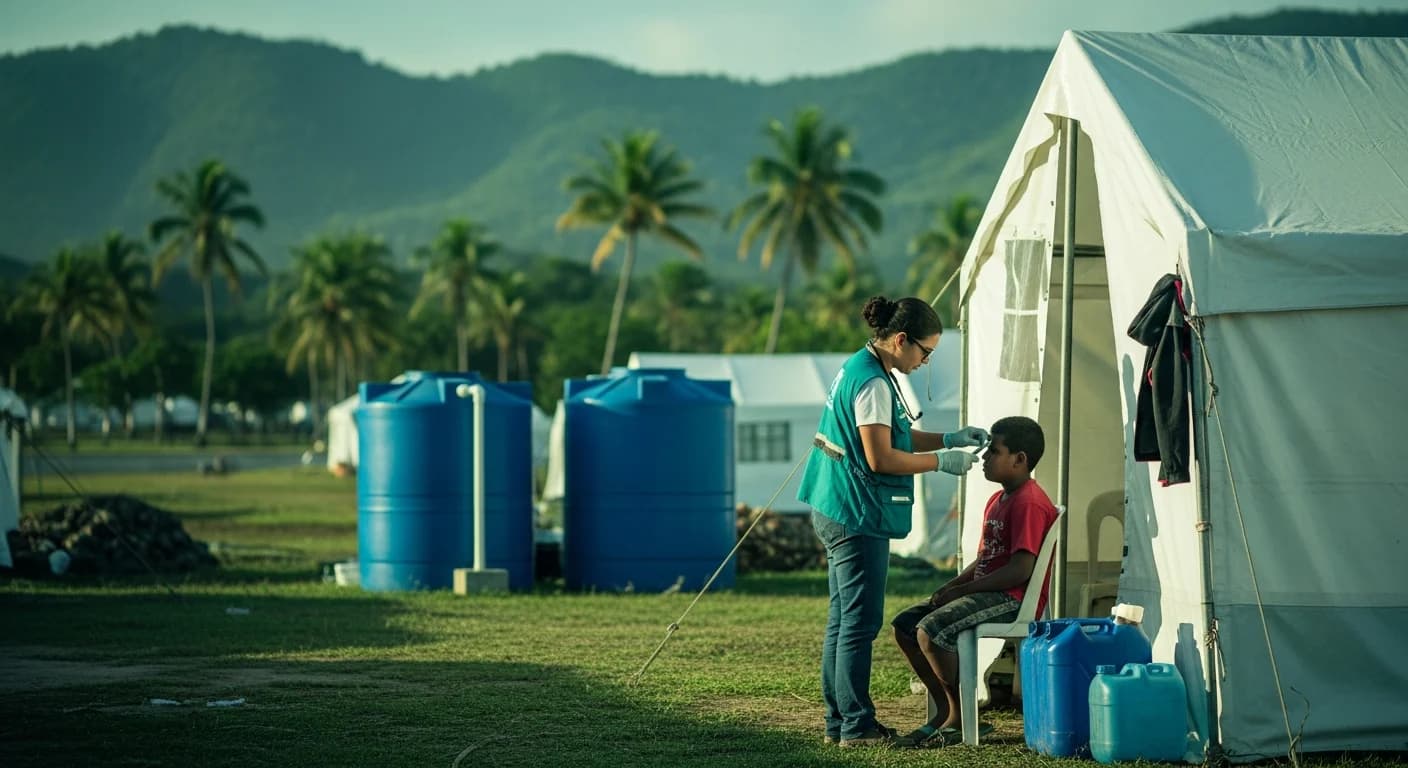
Safe water, sanitation, vectors and triage across the 107 temporary camps in northern Venezuela: concrete protocols for the physician in the field.
Across the 107 temporary camps currently active in northern Venezuela, the largest share of the disease burden a field physician will face does not come from acute trauma. It comes from contaminated water, inadequate sanitation and vectors. The sanitation protocols to prioritize, in order, are: secure safe drinking water, establish sanitation with effective excreta separation, set up syndromic surveillance for acute watery diarrhoea and febrile syndrome, and integrate vector control from day one.
This guide summarizes the clinical and public health decisions a general practitioner can implement with limited resources, and how remote consultation reinforces clinical decision-making when no specialist is available on site.
Which sanitation protocols should a physician prioritize in temporary camps
In a temporary settlement, the first 72 hours shape the epidemiological curve of the following weeks. The operational sequence recommended in PAHO/WHO emergency manuals and in the Sphere standards can be reduced to five priorities:
- Safe water in sufficient quantity. Ahead of any individual clinical intervention. Without treated water, every diarrhoea case you resolve will be replaced by three new ones.
- Sanitation and excreta disposal. Latrines that are sited, signposted and maintained. The faecal-oral route is the engine of camp outbreaks.
- Hand hygiene and community promotion. Soap, handwashing points and clear messaging in the language and register of the population served.
- Early syndromic surveillance. A simple register of acute watery diarrhoea, febrile syndrome, jaundice and respiratory symptoms detects an outbreak before laboratory confirmation arrives.
- Vector control. Breeding site removal, treated bed nets and protection of water storage.
Water and sanitation in Venezuela: the clinical baseline
Understanding the baseline prevents underestimating risk. Three figures frame the initial assessment:
- The R4V platform, coordinated by UNHCR and IOM, has documented more than 7.8 million Venezuelan refugees and migrants worldwide, the largest displacement crisis in the region. A camp population therefore typically mixes people in transit, returnees and host communities, with heterogeneous or unknown vaccination histories.
- UNICEF has consistently reported that several million people in Venezuela lack reliable access to safe water, with intermittent service across wide urban and peri-urban areas. On the ground this translates into prolonged household storage, the main point of recontamination.
- PAHO recorded 2024 as the worst dengue year in the history of the Americas, with more than 13 million cases reported across the region. Northern Venezuela is an endemic dengue transmission zone with active malaria foci.
Always verify current figures against the most recent situation reports from PAHO, UNHCR and UNICEF before planning resources, because they shift quickly during an emergency.
Safe water: chlorination, turbidity and point of use
The reference standard in humanitarian emergencies sets a minimum of 15 litres per person per day for drinking, cooking and basic hygiene, with a water point less than 500 metres from any shelter. As a physician your role is not to operate the treatment plant, but you should audit three parameters that tell you about clinical risk:
- Free residual chlorine of 0.2 to 0.5 mg/L at the delivery point under normal conditions. Where cholera is suspected or confirmed, the recommended threshold rises to 1.0 mg/L at the distribution point.
- Turbidity below 5 NTU. Above that value chlorination loses efficacy and prior flocculation or filtration is required.
- Household recontamination. Prioritize narrow-necked containers with a lid and tap. In camps, most contamination occurs after distribution, not before.
When the supply chain fails, point-of-use treatment with hypochlorite, chlorine tablets, ceramic filters or solar disinfection remains a high-yield intervention.
Sanitation and hygiene: breaking the faecal-oral route
Humanitarian standards recommend a maximum of 20 people per latrine, sited more than 30 metres from any water source, with the pit bottom at least 1.5 metres above the water table. In the coastal areas of northern Venezuela, where the water table is high and seasonal flooding is a real risk, that last condition is the one most often breached and the one that explains most outbreaks.
Add a short check to your daily clinical round: soap availability, latrine condition, medical waste management and separation from food preparation areas. A finding here prevents more cases than an extra consultation.
Waterborne disease: cholera, leptospirosis and hepatitis A
Acute watery diarrhoea and cholera. WHO estimates that the large majority of cholera cases can be treated successfully with oral rehydration salts alone. Set up an oral rehydration point at the entrance to the clinical area, ahead of triage: early rehydration reduces mortality more than any subsequent diagnostic decision. Reserve antibiotics for severely dehydrated cases, following local protocol and known susceptibility.
Leptospirosis. Suspect it in acute febrile syndrome with intense myalgia (particularly in the calves), conjunctival suffusion, jaundice or acute kidney injury in patients exposed to standing water or mud after rain or flooding. Early empirical treatment should not wait for serological confirmation.
Hepatitis A and typhoid fever. Consider both in jaundice or prolonged fever in a poor-sanitation setting, and report them to the surveillance system even without confirmatory laboratory capacity.
Vector control: dengue, malaria and febrile syndrome
Any febrile syndrome without a clear focus in northern Venezuela requires considering dengue and malaria simultaneously. Use a rapid malaria test where available, because treatment is time-dependent and clinical differentiation is unreliable. In dengue, the priority is not confirming the serotype but identifying warning signs: severe abdominal pain, persistent vomiting, mucosal bleeding, lethargy, tender hepatomegaly, or rising haematocrit with rapidly falling platelets.
Open water storage, unavoidable in a camp with intermittent service, is also the ideal breeding site for Aedes aegypti. Covering, screening and rotating stored water is a medical intervention, not merely a logistical one.
Field triage with limited resources
With scarce staff, a three-category system outperforms complex scales: emergency (airway compromise, shock, severe dehydration, active seizure, significant bleeding, respiratory distress), urgent (fever with warning signs, moderate dehydration, infected wounds, pregnancy with complications) and non-urgent. Reassess as a block every two hours: in dehydration and infection, the trajectory tells you more than any single measurement.
Explicitly prioritize children under five, pregnant women, older adults, people with decompensated chronic disease and people with disabilities.
Coordinating with PAHO/WHO, UNHCR and UNICEF
Do not work in isolation. Plug into the cluster coordination mechanism active in the area: health (typically led by PAHO/WHO), water and sanitation (UNICEF) and protection and camp management (UNHCR). Report cases to whatever early warning system is available, even unconfirmed suspicions, since early syndromic detection is the purpose of the system. Document each case with symptom onset date, location within the camp and water source used; that minimum dataset is what allows an outbreak to be mapped.
Telemedicine as clinical decision support in the field
WHO has historically identified a threshold of roughly 23 health professionals per 10,000 population as the minimum for essential services, and PAHO has proposed an even more demanding regional target. In humanitarian emergencies and in contexts of health worker emigration, that threshold is rarely met inside a camp.
Remote consultation does not replace physical examination or public health intervention, but it does resolve one concrete bottleneck: the second opinion. A general practitioner in the field can share a complex febrile case, an atypical skin lesion, a high-risk pregnancy or an acute psychiatric presentation with a remote colleague within minutes, and adjust management without transferring the patient. It also restores continuity for chronic patients (hypertension, diabetes, epilepsy, HIV) who lost their usual follow-up when they were displaced.
At Aliviaq we connect doctors with patients through secure video consultation, with clinical records and digital prescriptions. If you care for displaced populations or want to add your clinical experience to the network, sign up free on Aliviaq and start seeing patients today.
Frequently Asked Questions
How much water is needed per person per day in a temporary camp?
Reference humanitarian standards set a minimum of 15 litres per person per day for drinking, cooking and basic hygiene, with a water point less than 500 metres from any shelter. Below that threshold, the incidence of diarrhoea and skin infection rises measurably. During active diarrhoeal disease outbreaks, the recommended quantity increases.
What residual chlorine level is adequate to prevent cholera?
Under normal conditions, a free residual chlorine of 0.2 to 0.5 mg/L at the delivery point is recommended, with turbidity below 5 NTU so that disinfection is effective. Where cholera is suspected or confirmed, the recommended threshold rises to 1.0 mg/L at the distribution point, combined with household point-of-use treatment.
How can dengue be distinguished from leptospirosis in the field without a laboratory?
They overlap clinically, so both should be considered in parallel. Intense calf myalgia, conjunctival suffusion, jaundice, acute kidney injury and a history of contact with standing water or mud point toward leptospirosis. Rash, retro-orbital pain, leukopenia and progressive thrombocytopenia point toward dengue. With reasonable doubt in an endemic area, start empirical treatment for leptospirosis while monitoring for dengue warning signs.
What should I do if I suspect a diarrhoea outbreak in the camp?
Notify the health coordination mechanism and the available early warning system immediately, even without laboratory confirmation. In parallel, set up or reinforce the oral rehydration point ahead of triage, strengthen water chlorination, check latrine condition, and register every case with symptom onset date, location in the camp and water source used.
Is telemedicine useful in a camp without stable connectivity?
Yes, with limitations. Even with intermittent connectivity, remote consultation allows a specialist second opinion, continuity of care for displaced chronic patients and support for referral decisions. It does not replace physical examination, emergency care, or water and sanitation interventions, which remain the public health priority in the field.
Medicina General with extensive experience in telemedicine. Regular contributor to the AliviaQ health blog, committed to rigorous and accessible medical communication.