 AliviaQ
How to choose a telemedicine platform: a guide for doctors
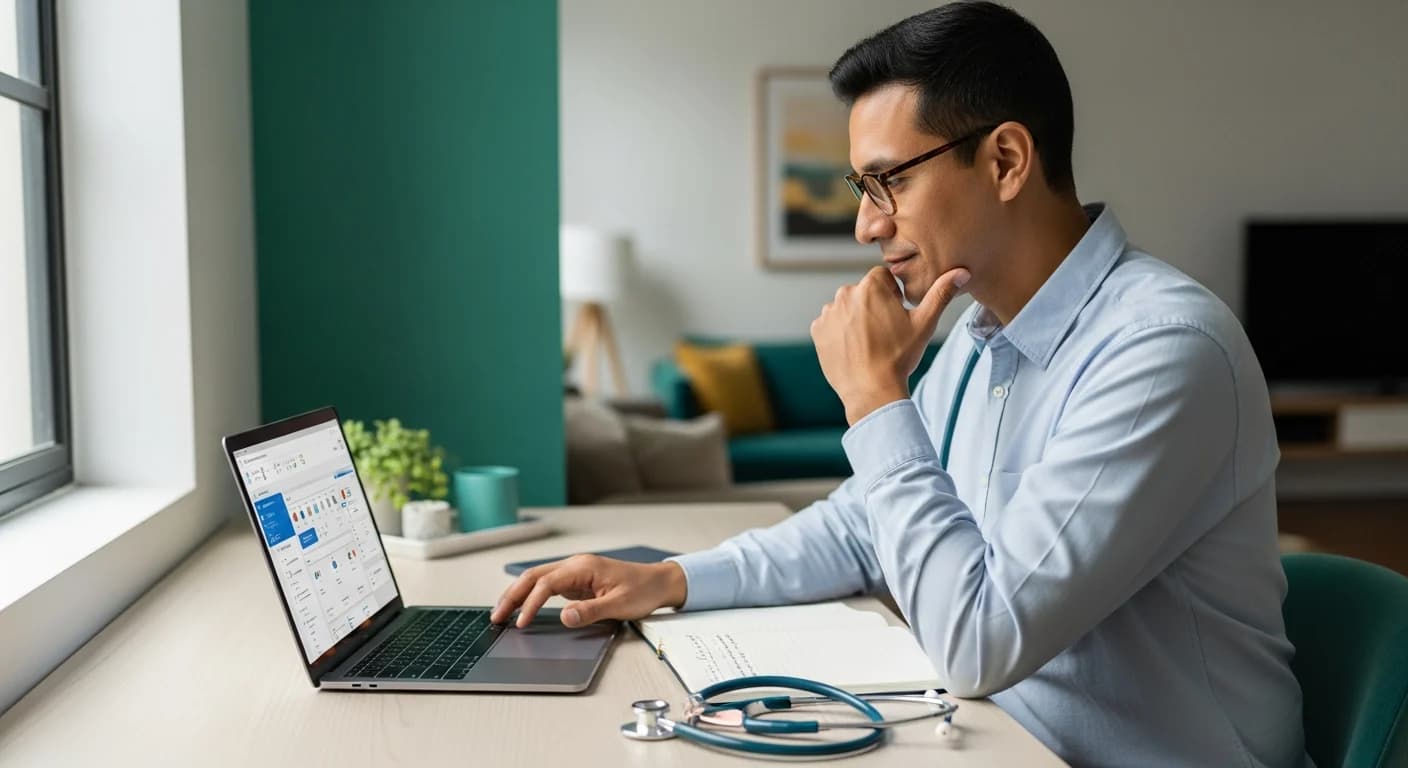
Verification, data, commissions, continuity and payment: the seven criteria worth checking before you sign up for any telemedicine platform.
Before you sign up for a telemedicine platform, check seven things: that it verifies medical credentials, that it protects clinical data, that its economic model is transparent, that it respects your relationship with the patient, that video consultations work on real-world connections, that you can issue valid clinical documents, and that payment actually reaches your country. Choosing badly costs time, reputation and, in some cases, legal exposure.
The number of platforms has grown sharply in recent years, and not all of them are built with the doctor in mind. Some are advertising directories; others are intermediaries that keep the patient relationship for themselves. This guide gives you concrete criteria for evaluating any of them before you hand over your data.
The 7 criteria for choosing a telemedicine platform
1. Check that they check
A serious platform requires your medical degree, licence or professional registration number and an identity document before activating your profile. If it lets you see patients ten minutes after signing up without verifying anything, that same carelessness applies to whoever is practising alongside you. Verification protects your reputation and tells the patient there is a real doctor on the other side.
2. Data protection and medical records
An online consultation generates health data, the most sensitive category in any privacy framework. Ask three questions: is the video call encrypted, where is the medical record stored, and can you export it. Be wary of platforms that run on generic messaging apps or that will not answer in writing about how data is processed. In Spain and the European Union this is governed by the GDPR; across LATAM the rules vary by country, but the clinical standard you should demand is the same.
3. The economic model, fine print included
There are three common models: a commission per consultation, a fixed monthly fee, and free access for the doctor. None is inherently bad, but you need the exact numbers: what percentage is withheld, whether there is a sign-up fee, whether you or the platform sets the consultation price, and what happens when a patient does not show up. If that information is not published before you register, that is an answer in itself.
4. Who owns the patient relationship?
This is the criterion most doctors overlook. Some platforms block follow-up outside their system or dissolve your profile into an anonymous pool of "available doctors". Check whether you can schedule your own patient for a review, whether you keep the clinical history if you leave, and whether your name is visible. Continuity of care is a clinical principle, not an optional software feature.
5. Technical quality in real conditions
Telemedicine in LATAM happens over mobile data, through power cuts and on limited bandwidth. Test the video call before committing: if it only works on fibre, it does not work for you. Check whether the patient has to install anything, whether there is a chat fallback when video drops, and whether you can reconnect to the same consultation without starting over.
6. Clinical documents and reports
You must be able to leave a written record of every consultation and give the patient a report carrying your name, your registration number and your instructions. On prescribing, rules differ by country and the platform has to tell you clearly what you can and cannot issue from its system. A platform that pushes you to prescribe without a clear legal framework is transferring its risk to you.
7. Make sure the money arrives
A payment model that does not land in your country is not a payment model. Confirm the available payment methods, the currency, settlement times and withdrawal fees. If you serve the diaspora, the key question is whether the platform accepts patients paying from abroad while the doctor is paid where they live.
Red flags when evaluating a platform
- Promises of patient volume with no explanation of where those patients come from.
- Exclusivity clauses that stop you working elsewhere or in your in-person practice.
- Terms and conditions you cannot read before registering.
- Nobody will state in writing who is responsible for processing the data.
- Pressure to see cases outside your specialty or to prescribe without an adequate assessment.
Telemedicine in Venezuela and LATAM: why now
The World Health Organization projects a shortfall of around 10 million health workers by 2030, concentrated in low- and middle-income countries, and sets the threshold needed to sustain essential services at roughly 44.5 professionals per 10,000 people. The WHO and the World Bank also estimated that some 4.5 billion people were not fully covered by essential health services in 2021.
In Venezuela and much of LATAM this shows up in your consulting room: patients travelling long distances for a ten-minute review, specialists concentrated in two or three cities, and families split by migration. The R4V platform estimates more than 7.9 million Venezuelan refugees and migrants, many of whom are still looking for a doctor who speaks their language and knows their history. The WHO approved its Global Strategy on Digital Health 2020-2025 precisely to give this transition some order. For doctors this is not a passing trend: it is concrete, sustained demand.
How a doctor registers with Aliviaq
Aliviaq is a platform in Spanish built for doctors serving Venezuela, including the diaspora. Registration is free for doctors: you create your profile, upload your documentation for verification, set your availability and fees, and start receiving video consultations straight from the browser, with nothing to install.
Apply the seven criteria in this guide to Aliviaq and to any other option you are weighing; the answers should be in writing and available before you register. If they convince you, sign up free on Aliviaq and start seeing patients today.
Frequently Asked Questions
What do I need to register on a telemedicine platform? A medical degree, a current licence or professional registration number, an identity document and an account to receive payments. Serious platforms verify that documentation before activating your profile.
How much does a telemedicine platform charge the doctor? It depends on the model: commission per consultation, a monthly fee, or free access. Ask for the exact percentage and the withdrawal terms in writing before registering. On Aliviaq, doctor registration is free.
Can I work on several telemedicine platforms at once? Generally yes, unless you have accepted an exclusivity clause. Check the terms before agreeing: exclusivity caps your income without guaranteeing you patient volume.
Is it legal to treat patients from another country by telemedicine? It depends on the rules of the country where the patient is and where you are licensed. Check the applicable rules before accepting cross-border consultations; the platform should give you clear information on this.
Can I prescribe in an online consultation? It depends on the country and its electronic prescription framework. The platform must tell you clearly which clinical documents you can validly issue from its system.
General Medicine with extensive experience in telemedicine. Regular contributor to the AliviaQ health blog, committed to rigorous and accessible medical communication.